
T5 Spinal Metastasis from Carcinoma Prostate, Treated with Dorsal Spine Decompression and Fixation
Patient's Initial Condition
Symptoms / Health Concerns
Inability to walk for the past 20 days
Weakness of both legs
Urinary retention requiring a Foley's catheter
Duration of Symptoms
Approximately 20 days (inability to walk and weakness of both legs)
Previous Treatments
Treatment for carcinoma prostate (previous history). No prior surgical treatment for the spine.
Diagnosis
Final Diagnosis
T5 spinal metastasis due to carcinoma prostate, with spinal cord compression causing lower limb weakness.
Tests / Scans / Investigations
MRI of the spine (T2 sagittal and post-contrast axial sequences) to assess the T5 lesion and the extent of spinal cord compression
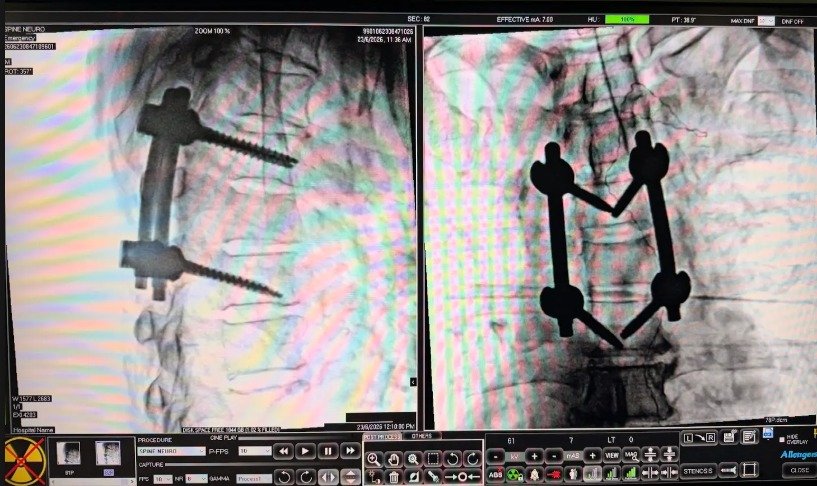
Intraoperative fluoroscopy (C-arm imaging) to confirm the position of the screws and rods during dorsal spine fixation
Treatment Details
Dorsal spine decompression and pedicle screw-rod fixation for T5 metastasis, with intraoperative fluoroscopic confirmation of implant placement.
Duration: One surgery, with follow-up at 3 months.
Advanced Techniques Used
Intraoperative fluoroscopy (C-arm imaging) for real-time guidance and confirmation of screw and rod placement
Posterior pedicle screw and rod fixation for spinal stabilization
Spinal cord decompression for metastatic cord compression
Results & Recovery
Patient Improvements
Regained lower limb power after surgery
Walked into the clinic on his own at the 3-month follow-up
Returned to his daily activities independently
Case Highlights
What Makes This Case Unique
A patient with spinal metastasis from carcinoma prostate who could not walk for 20 days, with weakness of both legs and urinary retention, regained full lower limb power after dorsal spine decompression and fixation. At 3 months he came walking to the clinic and was independent in his daily activities, even while continuing treatment for his primary cancer.
Most Significant Benefit
Regained the ability to walk and returned to independent daily living after being unable to walk for 20 days due to spinal cord compression.